



How to Create Brand Guidelines for Small Business.

Create Brand Guidelines That Make Your Business Look Professional
Introduction
Most small businesses begin with a logo and perhaps one brand color, then add new fonts, colors, and design choices whenever someone new works on marketing materials. Within a year, the website may look different from the Instagram page, and both may look different from the invoice template. The solution is to learn how to create brand guidelines for small business operations: one reference document that keeps every visual and message consistent, no matter who creates the content.
This guide explains exactly what to include in a brand guidelines document, how to build one step by step, and when it makes more sense to hire professional brand style guide services instead of creating one yourself, even for a business built around a focused niche such as NEMT or home health.

What Are Brand Guidelines, and Why Do They Matter?
Brand guidelines guide decisions; they do not make decisions for you. That is why agencies offering brand strategy development typically define positioning, audience research, and messaging first, then translate those strategic choices into the visual rules that shape the guidelines. A NEMT provider that jumps straight to colors and fonts often ends up with a style guide that looks polished but says little about the reliability and compliance the brand is built on.
Without clear guidelines, brand consistency depends entirely on memory, and memory does not scale. It breaks down as soon as a business grows, hires support, or expands into a new marketing channel.
Step 1: Define Your Brand Foundations Before Designing Anything
Before a small business can choose a single color or font, it needs to know its positioning, its target audience, and its personality. This foundational work typically lives inside a broader brand strategy process, because guidelines without strategy tend to feel arbitrary instead of intentional.
Why Brand Guidelines Start With Brand Strategy
Brand guidelines guide decisions; they do not make decisions for you. That is why agencies offering brand strategy development typically define positioning, audience research, and messaging first, then translate those strategic choices into the visual rules that shape the guidelines. A NEMT provider that jumps straight to colors and fonts often ends up with a style guide that looks polished but says little about the reliability and compliance the brand is built on.
Once the strategic basis is established, every guideline becomes easier to justify and easier to keep consistent, because every choice ties back to a clear reason rather than personal preference.
Step 2: Document Your Logo Usage Rules
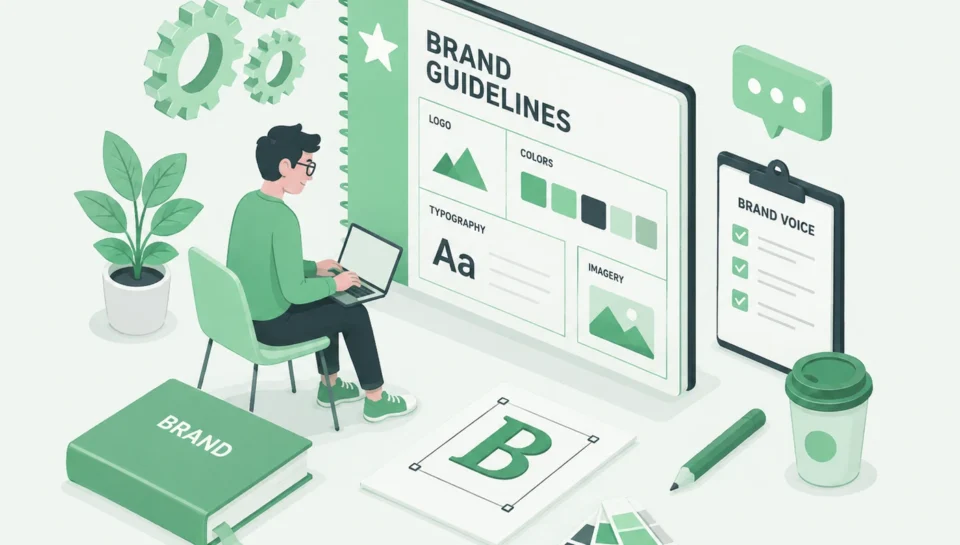
Identify the main logo, alternate versions, icon-only versions, minimum size specifications, clear space around the mark, and what not to do, such as stretching, recoloring, or placing the logo on a conflicting background.
Step 3: Lock In Your Color Palette
List the primary, secondary, and accent colors with exact hex, RGB, and CMYK values. Note which colors are meant for backgrounds versus text, and include accessibility notes on color contrast for readability.
Step 4: Choose and Document Typography
Select a headline typeface and a body typeface, specify the appropriate weights and sizes for headlines, subheadings, and body copy, and confirm that both remain readable on mobile screens, since most small business traffic is mobile-first.
Step 5: Set Imagery and Tone of Voice Rules
Determine whether photography should be bright and candid or polished and corporate, and write two or three sentences describing the brand tone, such as friendly and direct versus formal and authoritative. For a NEMT or home health brand, this is where trust and professionalism are built into every caption, email, and advertisement, not just the logo.
What to Include in a Complete Brand Style Guide
A full guidelines document generally includes:
- Brand story and mission overview
- Logo variations, spacing, and usage limitations
- Full color palette with technical values
- Typography hierarchy for titles and body copy
- Direction for iconography and imagery
- Tone of voice and example messages
- Application examples across web, social, and print media
DIY Brand Guidelines vs. Professional Brand Style Guide Services
A founder with design skills can draft a basic guidelines document using free templates. This can work for very early-stage businesses with limited budgets, but it has clear limitations.
- DIY guidelines are usually based on preference rather than audience data, so there is no strategic research behind the color and tone of choices.
- Professional brand style guide services often include competitor analysis and audience testing, along with a polished, presentation-ready document that can be shared with investors or partners.
- Agencies can also build supporting templates, such as social media layouts or email signatures, that a DIY guide usually will not include.
If you are a small business preparing to expand, hire a marketing team, or seek funding, professional brand style guide services can often pay for themselves by preventing costly inconsistency and rework later.
Common Mistakes When Creating Brand Guidelines
- Treating the guidelines as a one-time project rather than a living document that evolves with the brand
- Listing only a logo and colors while skipping typography, imagery, and tone of voice
- Writing rules that no one on the team reads or follows because the document is too long or too technical
- Not sharing the guidelines with freelancers, contractors, or new hires who create content
Frequently Asked Questions
How long should a small business brand guidelines document be?
Can I create brand guidelines myself without a designer?
What is included in professional brand style guide services?
How often should brand guidelines be updated?
Do brand guidelines help with SEO and content marketing?
Conclusion
Creating brand guidelines for small business needs does not require a large budget, but it does require starting with strategy rather than guesswork. A documented style guide makes consistency possible at every touchpoint, builds trust faster, and saves time on every design decision going forward. If your business needs a research-backed, presentation-ready result, consider professional brand style guide services built on a clear brand strategy foundation rather than assembled from templates alone.