


How to Outsource Administrative Tasks: A Step-by-Step Guide

How to Outsource Administrative Tasks: A Step-by-Step Guide
When administrative work consumes time that should be devoted to customers, strategy, or growth, outsourcing can be a practical solution. Tasks such as scheduling, inbox management, data entry, and invoicing rarely require executive judgment, but they do require consistency and clear processes. The goal is not simply to delegate work; it is to create a reliable system that improves efficiency without sacrificing quality or control.
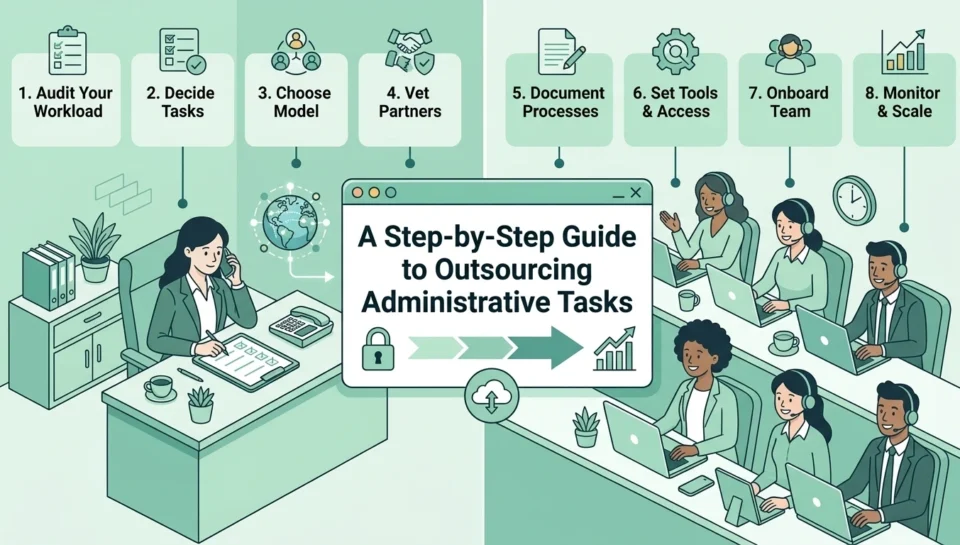
This step-by-step guide explains how to outsource administrative tasks effectively, from auditing your workload and choosing the right support model to documenting processes, onboarding a provider, and measuring results. Use the eight-step checklist below to build an outsourcing arrangement that is secure, scalable, and easy to manage.
Quick answer: To outsource administrative tasks successfully, identify repeatable work, begin with a low-risk pilot, select a provider that matches your volume and security needs, document each process, establish controlled access, and review performance before expanding the scope.
Step 1: Audit Your Current Workload
Before outsourcing any administrative work, determine where your team’s time is being spent. Track every task for five to seven working days, including its frequency, duration, owner, and level of business risk. This administrative task audit will help you distinguish work that can be delegated from responsibilities that should remain in-house.
A simple workflow audit usually turns up three categories of work:
- Recurring, rule-based tasks (scheduling, data entry, invoicing) — these are your best outsourcing candidates.
- Tasks that need context but not judgment (inbox triage, follow-up emails, document prep) — good candidates once you write down your preferences.
- Tasks that need your relationship, authority, or expertise (client negotiations, strategic decisions) — keep these in-house.
Skipping this step is a common cause of unsuccessful outsourcing arrangements. Effective delegation begins with a clearly defined task, owner, process, expected outcome, and escalation path.
Step 2: Decide What to Outsource First
Do not transfer your entire administrative function on the first day. Begin with one or two high-volume, low-complexity tasks from your audit, such as calendar management or data entry, and confirm that the arrangement works before expanding it.
An effective pilot task has three characteristics: it occurs frequently, follows a predictable process, and produces results that are easy to review and correct. This combination builds confidence while limiting operational risk.
Step 3: Choose the Right Outsourcing Model
The best administrative outsourcing model depends on your workload, budget, management capacity, security requirements, and need for backup coverage. Compare the following options before selecting a provider:
- Freelance virtual assistant: best for a handful of recurring tasks and a tighter budget. You hire and manage the person directly.
- Virtual assistant agency: the agency handles hiring, backup coverage, and quality checks, so there’s less management on your end.
- Business process outsourcing (BPO): built for higher task volume across multiple functions, with structured reporting and scalable business solutions as you grow.
If your requirements are still developing, begin with a limited pilot and compare providers against the same criteria. A virtual assistant agency may be appropriate when you need structured coverage and simpler scaling, while a freelancer may suit a smaller, stable workload. A BPO provider is generally better suited to higher volumes, multiple workflows, and formal reporting requirements.
Step 4: Vet Your Outsourcing Partner Properly
Evaluate an outsourcing provider with the same care you would apply to any important hire. Before committing to a third-party vendor, confirm the following:
- Relevant experience with your specific task type or industry
- Clear references or case studies you can verify
- A trial period or paid test project before a long-term commitment
- Documented data security and confidentiality practices, especially if the tasks involve financial or customer information
- Realistic turnaround times and a defined communication process
A short paid trial—typically one to two weeks using a real but low-risk task—provides more useful evidence than a sales presentation alone. Evaluate how the provider follows instructions, protects information, asks clarifying questions, meets deadlines, and reports progress.
Step 5: Document Your Processes Before You Hand Them Off
Process documentation is essential to a stable handoff. You do not need a fully developed manual to begin; a concise checklist, annotated example, or screen recording can provide enough detail for a pilot. Refine the documentation as the provider completes the task and identifies gaps.
For every task you outsource, write down:
• The exact steps, in order
• The tools and logins involved
• Your preferences, including tone of voice, formatting standards, and priority order
• A definition of successful completion, supported by an example where possible
Clear standard operating procedures (SOPs) enable an outsourced team to work independently, reduce repeated questions, and maintain consistent quality.
Step 6: Set Up Tools and Access
Provide access only to the systems and information required for the role, such as a shared inbox, calendar, project management platform, or specific software account. Use role-based permissions, separate user accounts, and multi-factor authentication wherever available instead of granting full account access.
A few practical safeguards worth setting up before day one:
- A shared password manager instead of sending credentials over email or chat
- A dedicated project management board so work and status are visible in one place
- Clear file-naming and folder conventions so nothing gets lost between systems
Remote administrative support operates most effectively when access controls are established before work begins. Retrofitting security measures later is more difficult and can introduce unnecessary risk.
Step 7: Onboard and Set Expectations
A structured onboarding process reduces repeated corrections and accelerates the transition. Review the SOPs with the new provider in a live session, not only in writing, and allow sufficient time for questions and clarification.
- Hold a kickoff call to walk through the first task end to end
- Set a daily or twice-weekly check-in for the first two to three weeks
- Agree on how urgent issues get flagged and how fast you’ll respond
- Give feedback on the first few completed tasks quickly, while the process is still fresh
Most early delegation problems result from unclear expectations, incomplete documentation, or delayed feedback rather than a lack of ability. A structured onboarding period helps the provider learn faster and gives your team a clear basis for evaluating progress.
Step 8: Monitor, Review, and Scale
Once the first task is operating consistently, assess performance against a small set of measurable service standards rather than relying on general impressions:
- Turnaround time against what you agreed on
- Error rate or number of corrections needed per week
- Whether SOPs needed updates to close recurring gaps
If the provider meets the agreed standards for three to four weeks, add the next task from your outsourcing checklist. Expand one process at a time, update the relevant SOP, and confirm that quality remains stable. This measured approach protects operational efficiency while turning a single delegated task into a scalable administrative support function.
Common Mistakes to Avoid
- Outsourcing everything at once instead of proving the model with one task first
- Skipping documentation and expecting someone to “figure it out”
- Giving full system access instead of role-based permissions
- Going quiet after onboarding instead of keeping a regular check-in rhythm
- Judging results after a few days instead of a few weeks
Frequently Asked Questions
How much does it cost to outsource administrative tasks?
What administrative tasks should I outsource first?
How long does it take to fully outsource an admin function?
Is outsourcing administrative work safe for sensitive data?
Should I hire a freelance VA or use an agency?
Turn repetitive administration into a documented, measurable system.
Ready to Hand Off Your Admin Work?
Najah Brand Elevation helps growing businesses design dependable administrative outsourcing solutions, from workload audits and process documentation to onboarding and scalable back-office support.
Explore Administrative Support Outsourcing and Plan Your First Pilot →